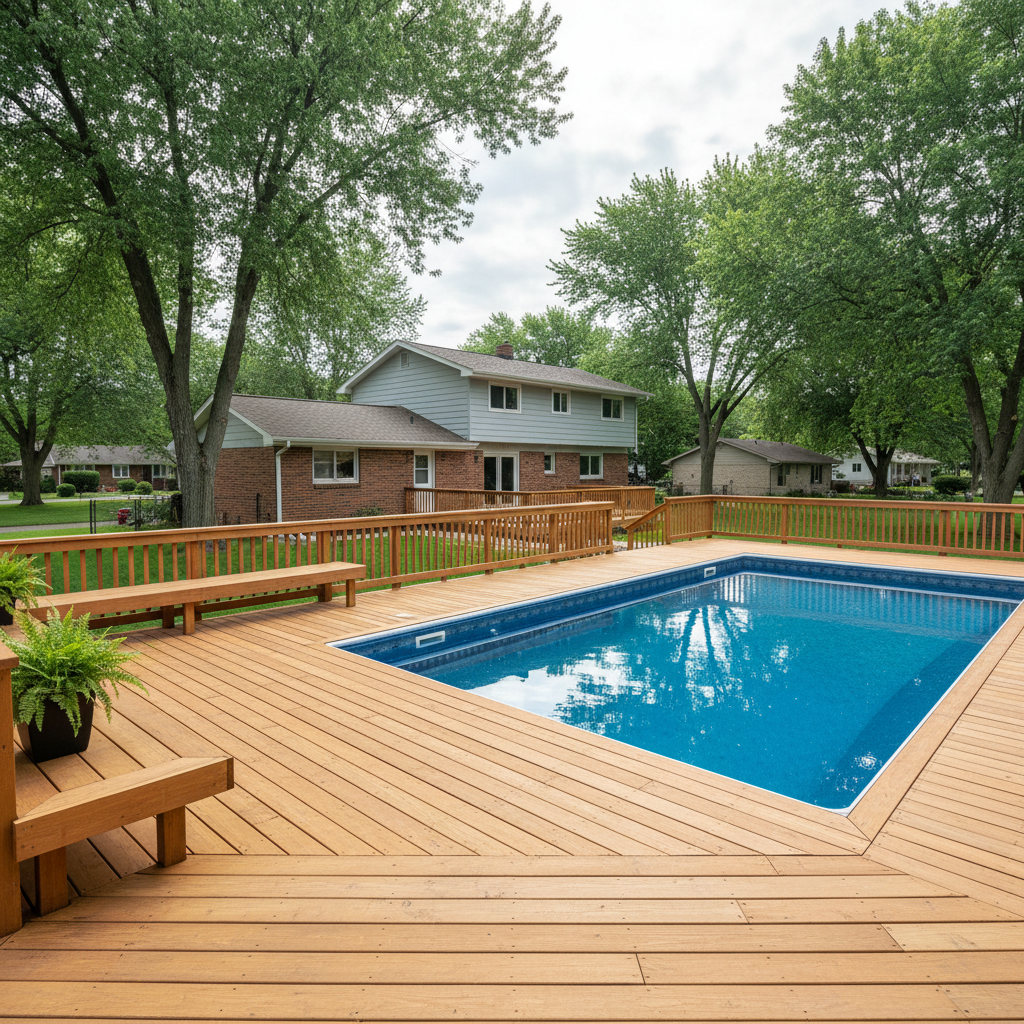
You have a pool in your backyard, or you are planning to get one. Now you are thinking about the deck that goes around it. This is a good idea. A pool without a proper deck is like a Minnesota winter without a good parka. It just does not feel right. You are probably wondering about the cost of a new Pool Deck project in St. Paul.
As a local contractor here in St. Paul, St Paul Deck Solutions has seen many Pool Deck projects. We can tell you that the price is not the same for every job. Many things can change the final numbers. Our team will give you the real facts about what to expect for your Pool Deck project in St. Paul.
What Affects Pool Deck Pricing in St. Paul?
A few important things really drive the cost of a Pool Deck. Understanding these items will help you make good choices for your Deck Construction project in St. Paul.
Material Choice is Key
This is probably the biggest factor for your Pool Deck. What you choose to build your Deck Construction out of will have a very big impact on the final price. Here is a quick list of common options and what they generally cost per square foot, with installation:
- Concrete: This is often the most cost-effective option for a Pool Deck. It usually costs from $6 to $18+ per square foot for a basic broom finish. If you choose stamped or decorative concrete, which can look like stone or tile, you are looking at $12 to $25 per square foot. Concrete is strong and handles our Minnesota freeze-thaw cycles well. This is especially true if it is 4000 PSI air-entrained concrete with rebar reinforcement.
- Pavers: These can cost you about $16 to $30 per square foot for your Pool Deck. Pavers offer a lot of design choices as well as good drainage.
- Wood (Pressure-Treated): This has the lowest initial cost for a Pool Deck. It is usually around $15 to $30 per square foot installed. However, wood needs a lot of maintenance around a pool. It takes in water, which leads to swelling as well as cracking as well as splinters if it is not sealed every year. You might need to replace boards in 5-7 years for your Pool Deck.
- Composite (like Trex): This is a very popular choice for Pool Deck Construction in Minnesota. Composite Decking typically costs $30 to $55 per square foot installed. It is made from recycled wood fiber as well as plastic. It resists fading as well as staining as well as scratching. It also needs less maintenance than wood.
- PVC (like TimberTech Azek, Wolf): This is the premium option for a Pool Deck. It often costs $40 to $70 per square foot installed. It contains no organic material. This means it is very resistant to moisture as well as rot as well as mold as well as insects. It is an excellent choice for Pool Decks. It offers great longevity as well as moisture resistance. This is important with our unpredictable St. Paul weather.
Size and Shape
A bigger Pool Deck means more materials as well as more labor. A simple rectangular shape will always be less expensive than something with complex curves as well as multiple levels as well as custom features. For an average-sized Pool Deck project in St. Paul, homeowners often spend between $5,000 and $15,000. It can go up to $35,000+ for a complex, multi-zone design.
Site Preparation and Access
If your yard needs a lot of grading as well as tree removal, or if access for equipment is tight, that will add to the cost. This is common in areas like Highland Park with narrow side yards. Uneven ground or sloped lots are common in some parts of St. Paul. These will increase excavation costs. They might also need additional structural work like retaining walls for your Pool Deck.
Features and Add-ons
Things like built-in lighting as well as custom railings as well as steps as well as benches will increase your total. A cool deck finish to reduce surface heat on sunny days will also add to the cost of your Pool Deck project.
Typical Cost Ranges for St. Paul Pool Decks
The cost "depends" on many things. However, St Paul Deck Solutions can give you some real numbers. These are based on what we have seen around the Twin Cities for Pool Deck Construction:
- Basic Concrete Deck (around 300-400 sq ft): You are probably looking at $4,000 - $10,000 for this Pool Deck. This would be a straightforward design with a standard finish.
- Mid-Range Composite Deck (around 300-400 sq ft): Expect to pay $9,000 - $22,000 for this Pool Deck. This gives you a strong as well as low-maintenance surface with good looks.
- Premium PVC or Stamped Concrete Deck (300-400 sq ft, with features): This could easily cost $12,000 - $28,000+. This would include more complex designs as well as decorative finishes. It might also include some built-in elements for your Pool Deck.
Remember, these numbers are for the Pool Deck itself. The pool installation is a completely separate cost. It is a big one. It often ranges from $43,000 to over $86,000 for an in-ground pool.
What Should Be Included in a Quote?
When you get a quote from a contractor, make sure it is detailed. A good quote from St Paul Deck Solutions should clearly break down the costs. Any good builder will do this for your Pool Deck project:
- Materials: This includes the specific type as well as brand as well as quantity.
- Labor: This covers hours and rates for demolition, if it is needed. It also includes site prep as well as framing as well as installation as well as finishing. Labor can be 40-55% of the total Pool Deck project cost.
- Site Preparation: This includes excavation as well as grading as well as debris removal.
- Permits and Inspections: In St. Paul, you will definitely need permits for a new Pool Deck. These can range from $150 to $600. They can be even more depending on the complexity of the Pool Deck project. A good contractor will handle this for you.
- Foundation/Footings: In Minnesota, footings need to be 42 inches deep. This gets them below the frost line. This prevents shifting during our harsh winters.
- Finishing Touches: This means sealants as well as non-slip textures. Non-slip textures are very important for Pool Decks. It also includes any decorative elements.
- Warranty Information: This covers both materials as well as workmanship for your Pool Deck.
How to Avoid Overpaying for Your Pool Deck
Nobody wants to feel like they paid too much. Here is how to be a smart homeowner for your Pool Deck project in St. Paul:
- Get Multiple Quotes: Do not just go with the first person you talk to. Get at least three detailed quotes from different contractors. This helps you compare things fairly. It also helps you understand the market rate for a Pool Deck.
- Be Specific About Your Vision: The more details you give upfront, the more accurate your quotes will be. This includes materials as well as size as well as features. Changes during the project almost always cost more money.
- Consider Phasing Your Project: If your budget is tight, you might build a smaller, simpler Pool Deck now. You can add features like built-in seating or elaborate landscaping later.
- Choose Materials Wisely: Pressure-treated wood might seem cheaper at first. However, the long-term maintenance as well as shorter lifespan around a pool could make it more expensive. This is compared to composite or PVC in the long run for your Pool Deck.
- Do Not Skimp on Site Prep or Footings: This is especially true in our St. Paul climate. Proper foundation work is important to prevent problems later on. These problems would be much more expensive to fix for your Pool Deck.
- Ask About Off-Season Discounts: Sometimes contractors might offer small discounts during slower times. This is usually in the late fall or winter. However, Pool Deck work is often seasonal.
- Review Everything: Read your contract carefully for your Pool Deck. Make sure all costs are listed. Make sure there are no hidden fees. If something is unclear, ask questions.
Building a Pool Deck is a big investment. It adds a lot to your home's enjoyment as well as its value. Do your research. Ask the right questions. St Paul Deck Solutions will help you end up with a beautiful as well as useful space. You and your family will enjoy it for many years in St. Paul.