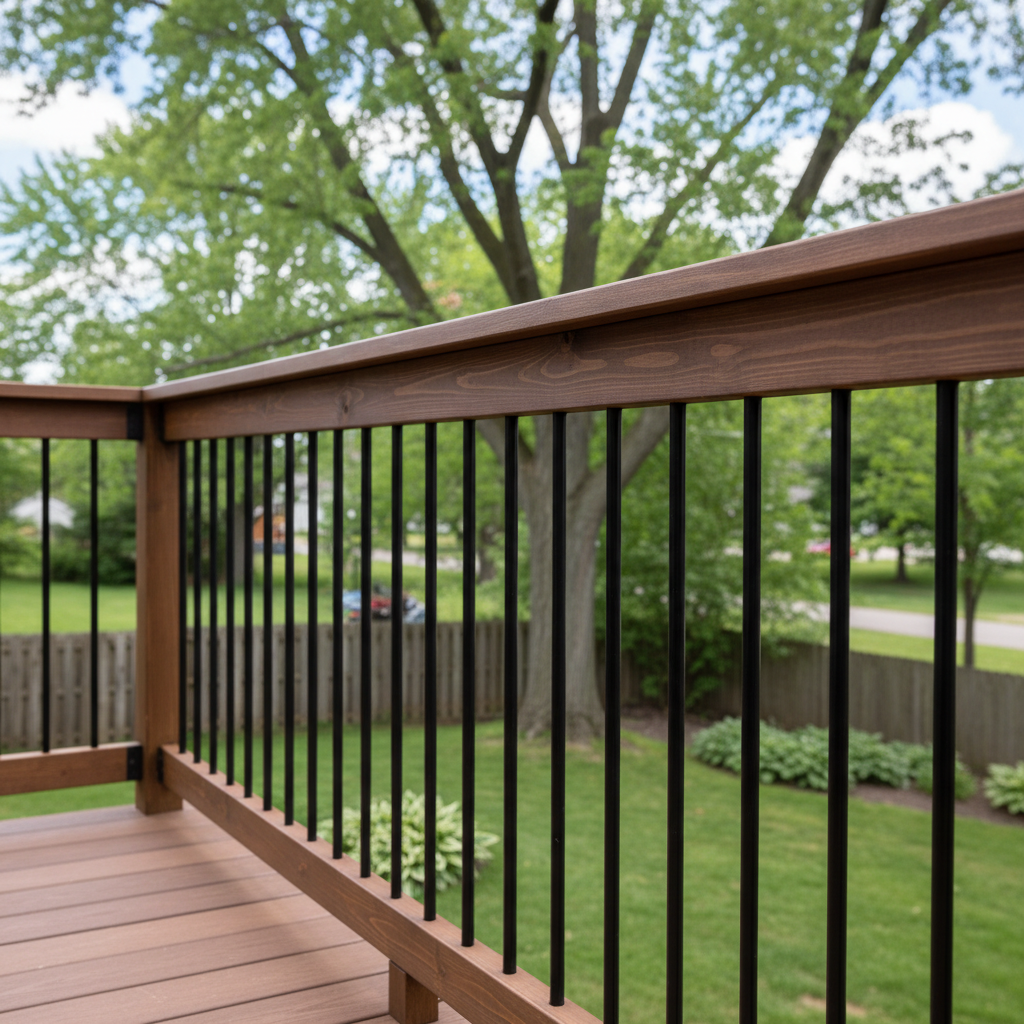
What's the deal with railing height and spacing? Are there specific codes I need to worry about in St. Paul?
Oh, absolutely, there are codes, and you definitely need to pay attention to them. It's not just about how nice your deck looks; it's about keeping people safe, and the city of St. Paul takes that seriously. For residential decks, the general rule is that your railing needs to stand at least 36 inches high from the deck surface. If your deck sits more than 30 inches off the ground, you'll need a railing. Now, the spacing – that's where people sometimes get confused. The code says a 4-inch sphere can't pass through any opening in your railing. That means the gaps between your balusters (those vertical posts) can't be more than four inches wide. We often call this the 'baby's head' rule, and it's there to stop small children from falling through or getting stuck. Don't forget about the triangle formed by the bottom rail, the deck surface, and the baluster – that also has to meet the 4-inch sphere rule. I've seen folks try to DIY this, only to have to redo entire sections because they didn't think about the angle. Always double-check with the St. Paul Department of Safety and Inspections if you're unsure, or just hire a pro like St Paul Deck Solutions who really knows the ropes.
I've heard about 'graspable' handrails. Do I need one, and what does that even mean?
You heard right. Graspable handrails are a real thing, and whether you need one just depends on your deck's design. If your deck has three or more risers (that's steps, in plain English) or a total rise of 30 inches or more, you'll probably need a graspable handrail right alongside your guardrail. The guardrail, of course, stops falls off the edge; the handrail gives you stability when you're using the stairs. So, what does 'graspable' actually mean? It means you can comfortably wrap your hand around it and hold on securely. Think about a stair railing inside your house. It can't be too big, too small, or have some weird shape that makes it tough to grip. Codes allow for specific dimensions and profiles, usually a circular cross-section between 1-1/4 and 2 inches in diameter, or a non-circular shape with a perimeter between 4 and 6-1/4 inches. It also needs to be continuous, without newel posts breaking it up. This is super important for accessibility and preventing slips and falls, especially during our icy St. Paul winters.
Can I mix and match different railing materials, like wood posts with metal balusters?
You absolutely can mix and match materials, and it's a really popular choice for a good reason. Combining materials can give your deck a truly custom, high-end look. Wood posts, especially larger cedar or treated lumber, give you a sturdy, classic base, while metal balusters (often aluminum or steel) offer a sleek, modern aesthetic and can be much thinner, which really opens up your view. You could also go with composite posts and then use aluminum or glass infill. The main thing is making sure all the components work together and are secured properly. For instance, if you're attaching metal balusters to wood, you need to use the right fasteners – ones that won't corrode the metal or degrade the wood over time. Also, consider how different materials expand and contract with our wild temperature swings here in Minnesota. A good contractor will know how to plan for that to avoid problems down the road. It's all about smart design and correct installation.
What's the most durable railing option for our climate? I'm tired of constant maintenance.
If you're after durability and low maintenance in our St. Paul climate, you'll probably want to lean towards composite, PVC, or aluminum railings. Wood, even if it's pressure-treated or cedar, needs regular staining, sealing, or painting, and it can still warp, crack, or rot eventually. Composite railings, made from a blend of wood fibers and plastic, are incredibly tough. They fight off rot, insects, and fading, and they don't need painting or staining – just an occasional cleaning. PVC railings are pretty similar, offering excellent weather resistance and very little upkeep. Aluminum railings are another fantastic choice. They're lightweight, strong, won't rust, and come with durable powder-coated finishes that hold up really well against sun, rain, and snow. They're usually a bit pricier upfront, but the time and money you save on maintenance over the years often make them the most cost-effective long-term solution. You'll spend more time enjoying your deck and less time working on it, which sounds pretty good to me.
How long does railing installation typically take?
That's a tough one to give a single answer for because it really depends on a few things: the size and complexity of your deck, the type of railing system you pick, and whether it's a brand new deck or just a railing replacement. For a typical 12x16 foot deck, putting in a basic wood or composite railing system might take a day or two for an experienced crew. If you're going with a more intricate design, like custom metalwork, glass panels, or a cable railing system, it could easily stretch to three to five days, sometimes even longer. Prep work, like taking off old railings or beefing up posts, also adds time. And don't forget about inspections – sometimes the city wants to inspect the framing before the railings go on, and then the final product. We always try to give you an honest timeline upfront, but sometimes things like unexpected weather (hello, spring snow in April!) can throw a wrench in the schedule. Communication is key, so we'll always keep you in the loop.
My deck is old and the posts are wobbly. Can I just replace the railings, or do I need a whole new deck?
This is a common question, and it really depends on how bad the problem is. If it's just the railing itself that's wobbly, and the deck's structural posts, joists, and ledger board are all solid and in good shape, then yes, you can often just replace the railings. We'd inspect the existing posts that the railings attach to. If those posts are sound, we can usually reuse them or reinforce them. However, if the wobble is coming from the main deck posts, or if the deck surface itself feels soft, spongy, or shows signs of significant rot, then replacing just the railings would be like putting a new hat on a crumbling foundation. It won't solve the underlying safety issue, will it? We'll do a thorough inspection to assess the integrity of the entire deck structure. Sometimes, we find that while the deck surface is okay, the ledger board (where the deck attaches to your house) is compromised, especially in older homes in areas like Merriam Park where decks might be 30-40 years old. We'll give you an honest assessment of what's truly needed to make your deck safe and up to code, whether that's just new railings or a more extensive repair or replacement.
What's the deal with cable railings? Are they safe for kids and pets?
Cable railings are definitely stylish and give you an unobstructed view, which is why they've become so popular. They're made of thin horizontal or vertical stainless steel cables stretched taut between posts. As for safety, when they're installed correctly, they are absolutely safe. The key phrase there is 'installed correctly.' For horizontal cables, the spacing between them is super important to meet that 4-inch sphere rule we talked about earlier. If the cables aren't tensioned properly or are spaced too far apart, a child could potentially squeeze through or use them like a ladder to climb. For pets, especially smaller ones, horizontal cables might offer an escape route if the spacing is too wide, or if they're particularly agile. Vertical cable railings eliminate the 'ladder effect' concern entirely, making them a very safe option. The quality of the components and the expertise of the installer make all the difference. Don't skimp on either if you're considering cable railings; you want those cables drum-tight and spaced perfectly.